|
NEW STING FOR THE .22 HORNET!
New popularity
for the classic .22 Hornet cartridge has fueled the development of new
premium- bullet factory loads and the first-ever commercial double- and
single-action revolvers chambered for the round.
The
venerable and diminutive .22 Hornet is among the most enduringly popular
centerfire cartridges in firearms history. Supernaturally accurate, with
minimal recoil, the Hornet has been (or currently is) chambered in a
variety of different models and action types by every leading rifle
manufacturer at home and abroad, and it has also found a secure home in
precision shooting pistols as the Anschutz Exemplar and Thompson/Center
Contender.
Now, there are two entirely new handguns
chambered for this delightful little round: both revolvers (that?s right,
revolvers). One is an eight-shot version of the massive new Ranging Bull
(RB) double-action design from Taurus, and the other is the Little Max
six-shot version of the new Magnum Research Inc. (MRI) single-action BFR.
The appearance of these two different makers' guns on the
market at literally the same moment is a remarkable coincidence,
especially in view of the fact that the other leading revolver
manufacturers previously tried, failed, and essentially gave up on the
notion of producing tapered-case .22 centerfire varmint revolvers a
quarter-century ago because of problems with cylinders freezing due to
case setback from the chambers when firing. These two new guns avoid that
problem in an interesting way and provide a unique application for the .22
Hornet cartridge. Shooting Times was privileged to receive the very first
shooting samples of both revolvers, so let's take a look at them.
SOLVING THE SETBACK PROBLEM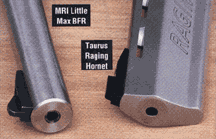
Every experienced shooter I've mentioned these new .22
Hornet revolvers to has immediately asked, "How can they keep the tapered
cases from setting back and locking up the cylinder?" So, I'll address
this issue right off the mark. The question stems from the well-known fate
of the Smith & Wesson Model 53 revolver, manufactured from 1961 to
1974. This double-action revolver was chambered for the .22 Remington Jet,
a centerfire .223-caliber cartridge built on a necked-down .357 Magnum
case with a tapered shoulder that would generate approximately 1800 fps
velocity with a 40-grain softpoint bullet from an 8 3/8-inch revolver
barrel. It was a precision shooting tool with several unique features,
including a rotating rimfire/centerfire striker in the hammer and aluminum
chamber inserts to allow interchangeable use of .22 Long Rifle rimfire
ammunition. Unfortunately, the Jet case would frequently back out of the
Model 53 chamber at the moment of ignition and "weld" itself over the
firing pin hole, stopping the cylinder. Of the chambers were roughened to
prevent setback, extraction became difficult, often requiring a mallet to
knock the ejector rod. S&W finally got tired of Model 53s coming
back to the service department to fix the unfixable and dropped the gun
from its catalog. No revolvermaker since has dared try to chamber
for a tapered- or shoulder-case, high-velocity cartridge.
Until now, that is. And I'll cut right to the chase and tell
you that neither the review sample .22 Hornet single-action MRI nor the
double-action Taurus Raging Bull had any problem whatsoever with case
setback or difficult extraction. In loading their cylinders full—six for
the BFR, eight for the Taurus—and running them through rapid-fire, I
experienced no drag or hangup. And when I opened the loading gate on the
BFR or swung out the Raging Bull's cylinder, the fired cases dropped out
into my hand, pushing the extractor rod was barely required.
 The reason for these revolvers? success
is their ignition design. Both employ positive transfer bar safety ignition
systems, similar in design, wherein a flat-fronted hammer transfers
its force through an intervening piece of metal to a spring-loaded firing
pin in the frame. By comparison, the direct-impact hammer-ignition design
of the old K-Frame S&W Model 53 was lightweight, without sufficient
mass to hold forward at the moment of ignition, and allowed the rearward
force of the fired case to kick back hard enough against the firing
pin to bounce the hammer. With the Taurus and MRI .22 Hornet revolvers,
the entire combined masses of their heavier hammers and transfer bars
provide sufficient inertial resistance against rearward case movement
at the critical ignition instant (or so the engineers say). The threshold
force is probably very close to the edge, but it's nonetheless enough
to eliminate the setback problem. Whatever the exact technical explanation,
cylinder rotation of both guns works flawlessly. The reason for these revolvers? success
is their ignition design. Both employ positive transfer bar safety ignition
systems, similar in design, wherein a flat-fronted hammer transfers
its force through an intervening piece of metal to a spring-loaded firing
pin in the frame. By comparison, the direct-impact hammer-ignition design
of the old K-Frame S&W Model 53 was lightweight, without sufficient
mass to hold forward at the moment of ignition, and allowed the rearward
force of the fired case to kick back hard enough against the firing
pin to bounce the hammer. With the Taurus and MRI .22 Hornet revolvers,
the entire combined masses of their heavier hammers and transfer bars
provide sufficient inertial resistance against rearward case movement
at the critical ignition instant (or so the engineers say). The threshold
force is probably very close to the edge, but it's nonetheless enough
to eliminate the setback problem. Whatever the exact technical explanation,
cylinder rotation of both guns works flawlessly.
Of course, beyond their similar transfer bar
ignition mechanisms and the fact that both are offered with 10-inch
barrels, the DA Taurus and SA MRI .22 Hornet revolvers are quite
different.
TAURUS' DA RAGING HORNET
The
double-action Taurus revolver is designated as the Model 22H raging Hornet
(with appropriate bold barrel logo) and is built on the massive new Taurus
raging Bull frame, action, grip, and barrel system introduced last year
for the profoundly powerful 50,000+psi .454 Casull cartridge. As such, it
can easily handle the 43,000 max-psi .22 Hornet loads. Like the
.454-caliber version, the Model 22H features a dual-latch independent
locking system for the eight-shot cylinder and a recoil-cushioning
shock-absorber insert in the rubber grip (scarcely needed since recoil on
the 10-inch, nearly five-pound Hornet revolver is virtually nonexistent).
To sustain the Hornet motif, according to Taurus, the grip insert on the
Model 22H will be bright yellow instead of the signature red color of the
.454 Casull, .45 Colt, and .44 Magnum versions.(Note, however, that the
review sample Raging Hornet had a red grip insert.)
The
barrel is also distinctive. Unlike the barrels on all other Taurus
revolvers, which the company manufactures itself, the hammer-forged
10-inch stainless-steel Raging Hornet barrels are purchased from Lothar
Walther in Germany, already precisely bored and rifled, then shipped to
Brazil where they are shaped and finished to the standard external
dimensions of the Raging Bull series and fitted to the frames. Thanks to
the extra "varmint revolver" length and overall heavy weight, the Hornet
barrels don't have the integral expansion chamber compensator found on the
big-bore magnum versions. It's simply not needed. The review sample
prototype .22 Hornet revolver featured a sling swivel stud in the bottom
barrel lug just in front of the ejector rod slot—a sling is surprisingly
more useful than a holster for carrying this heavy guns in the field while
hiking to a woodchuck post.
All other features of the
Model .22H—sights, scope mount options, mechanical trigger action—are
common to the Raging Bull series. Our review sample Raging Hornet revolver
came from Taurus already set up with a variable Burris 3-9X handgun scope
on a frame mount. Generally, I prefer barrel mounts on scoped revolvers to
reduce the protrusion of the scope?s eyepiece behind the gun, but due to
the shorter eye relief of the higher magnification scopes appropriate for
this chambering, the frame mount here is actually more practical and
easier to use.
MRI'S SA BFR
Turning to the
single-action Magnum Research .22 Hornet BFR (MRI spokesmen insists the
initials officially mean: Biggest, Finest Revolver"; the revolver?s frame
is marked Magnum's BFR"), the first thing noticeable is how similar in
form and function it is to a Ruger Super Blackhawk. No surprise; the
revolver's manufacturer, D-Max Inc. of Springfield, South Dakota, buys the
BFR series grip frames directly from Ruger, and the gun utilizes the
well-known Ruger SA transfer bar ignition system and
loading-gate/cylinder-rotation release mechanism. In fact, to look at the
gun, the only apparent difference between it and an actual Ruger Super
Blackhawk (SBH) appears to be added mass at the upper front area of the
cylinder frame to provide the strength necessary for those other version
of the gun that are chambered for cartridges including the .454 Casull,
.50 Action Express, and even (in a longer cylinder design), the .444
Marlin and .45-70 Gov't. Maybe BFR also stands for "Bigger, Fatter Ruger."
(Watch for a complete performance review of all the varied revolver
variations and chamberings in the MRI BFR lineup in a forthcoming issue of
Shooting Times.)
Everything about the sample BFR .22 Hornet
was finely fitted and tightly gauged. Overall finish is a satin natural
stainless steel with black Pachmayr rubber grips (the standard Ruger SBH
model). The hammer has a grooved and slightly widened semitarget spur.
Trigger pull measured a smooth 4.25 pounds, with the slight creep inherent
to all SA transfer bar ignition systems. The straight bull barrel has
a flat-cut muzzle. The six-shot cylinder is not counterbored.
The review revolver came equipped with precision adjustable
Millett sights featuring white-outline rear notch and highly visible
fluorescent orange Baughman-style ramped front blade. These are excellent,
but a .22 Hornet handguns really needs a scope to make is really sting.
MRI does not yet offer ant proprietary mount for the BFR revolver series,
but its technical people tell me that any standard frame-attach mount base
system for the Ruger Super Blackhawk can be used, due to the identical
dimensions of the rear sight slot on both the Ruger SBH and the BFR. Of
course, this requires drilling and tapping of the BFR topstrap, which I
was loath to do, so I rummaged around in my mount inventory and came up
with an old B-Square Mono-Mount (no longer on production) for the SBH;
it's a one-clamp system designed to attach to the full-round 10-inch Ruger
.44 Magnum's bull barrel ahead of the ejector rod housing. The barrel
diameter of the .22 Hornet BFR is actually a bit bigger than the Ruger .44
Magnum SBH's, but the aluminum body of the Mono-Mount was sufficiently
elastic to conform around the larger surface when tightened down with
B-Square's heavy duty hex screws, and it provided a rock-solid base for
the Burris 7X scope I selected.
WOODCHUCK-GRADE
PERFORMANCE
With both guns checked thoroughly over and scopes in
place, I gathered up a quantity of the five currently available
American-made .22 Hornet factory loads and headed for the range. In
addition to the two revolvers, I also brought along a 10-inch T/C
Contender chambered for .22 Hornet as well as my old bolt-action .22
Hornet Anschutz "Exemplar" pistol (also a 10-incher). Both are
extraordinarily accurate guns and I was interested in how the solid-breech
designs through a matched review series on a load-for-load basis. Plus I
had a new laminated stock Ruger Model 77/22 All-Weather .22 Hornet rifle
fitted with one of Weaver's brand-new 6-24X target scopes, which I had
already planned to use to check out and compare the accuracy and gel-block
impact performance of Hornady's hot new V-MAX .22 Hornet cartridge (see
the accompanying sidebar on .22 Hornet ammunition). I fired all five
available factory loads through all five guns for velocity and accuracy at
50 yards and 100 yards, and the results are listed in the accompanying
chart. Several interesting things emerged. The critical fact for his
review is that the Hornet revolvers shot very well indeed, and very much
alike in combined averages. Their overall group figures placed at about
1.25 to 1.5 inches at 50 yards and about 3.5 to 4.0 inches at 100 yards.
Of course, that may not seem impressive alongside some of the results
posted by the Ruger rifle or the Anschutz Exemplar, but these are
revolvers, after all, and I have always held that any revolver of any
caliber that can hold 2.5 inches or better at 50 yards, or less than four
inches at 100 yards, is an exceptional revolver indeed. A 1.25-inch group
at 50 yards is a close-focus headshot on any target you name. Plus the
combined averages don't tell the entire story. There was a considerable
variation in consistency of performance load to load, and all the
individual guns were very picky about which loads they liked best. A key
factor appears to be powder burn rate and barrel length. For reasons known
only to God, there was a large amount of statistically random velocity
variation with all loads throughout all guns—more than 200 fps with some
load/gun combinations. This large round-to-round variation did not seem to
have much effect on the 50-yard group results, but at 100 yards the less
consistent velocities were translating into less consistent accuracy.
There are an abundance of intersecting variables to consider, but the
pattern seems to indicate that the loads with small velocity variation
combined with faster twist-rate bores yielded better long-range accuracy.
So the 35-grain Hornady V-MAX load did better from the
1:9-inch twist MRI BFR revolver (with 65fps variation) at 100 yards than
it did from the 1:16-inch twist Taurus Raging Hornet (with 135 fps
variation), yet the Raging Hornet shot the Remington 45-grainPSP (with 57
fps variation) measurably better at that same distance than did the T/C
Contender (with 249 fps variation) which has a 1:14-inch rifling twist
rate. The practical conclusion is that with the loads they like best, both
of these revolvers will give you a factory-load woodchuck anchor, and
crows dropping from the trees, out to at least 100 yards, but you'll need
to do your range homework with a full variety of ammunition to find out
which works best in your own gun. Handloaders ought to love all this, as
the opportunity to experiment with different propellants to discover which
give optimum consistency in the 10-inch revolver barrels offers an
intriguing challenge.
The occasional encounter with items
like these two new revolvers reminds me that the reason I love this job in
the first place is because some guns and cartridge loads are so much fun
to take out and shoot. And that's exactly what the new Taurus Model 22H
and the MRI Little Max .22 Hornet handguns are—just plain fun.
.22 Hornet Myths & Realities
With several new
guns and new ammunition loads now reaching the market, it's time for a
fresh look at the myths and realities surrounding the .22 Hornet?s history
and capabilities and its overall place in the ammunition continuum.
As a "rifle" cartridge with widely used handgun applications, the .22
Hornet has a variety of interesting characteristics. It was originated
during the 1920s by army Captain G.L. Wotkyns, who was looking to upgrade
the relatively slow (1550 fps) 1185 .22 Winchester Center Fire (WCF) into
a higher velocity, longer range woodchuck/crow/varmint cartridge. The .22
WCF's actual caliber diameter was about .226 inch, so he necked the
tapered case down to accept 45-grain .223-caliber bullets that would match
the bore of the Model 1922 Springfileld .22 LR rimfire rifle barrel he had
rechambered to accept the .22 WCF cartridge and powered the load up to a
guestimated 2400 to 2600 fps with Hercules No. 1204 powder. Groups
averaged about an inch at 100 yards.
Wotkyns communicated his
preliminary results to the legendary Colonel. Townsend Whelen at the
Springfield Armory, who was sufficiently impressed to enlist a pair of
coworkers and pursue Wotkyns? development and propellant research.
The No. 1204 powder did not prove as consistent as desired, so
Whelen persuaded Hercules to pitch in. The result was a new small-case
propellant that would deliver a consistent 2400 fps velocity with 45-grain
bullets from the modified .22 WCF case, and the powder went on the market
as the soon-to-be-classic Hercules "2400" (now you know; and how
interesting it is that 2400 would be the powder Elmer Keith later
standardized in his creation of the .44 Magnum). Incidentally, Hercules
brand powders are now made and distributed by Alliant Powder Co., Dept ST,
Rte. 114, Box 6, Radford, VA 24141.
Winchester picked up the
ball around 1928 with a rechambered .22 rimfire rifle and experimental
ammunition of its own. The accuracy results surpassed any cartridge the
company had ever before developed, and the first of ".22 Winchester
Hornet" ammunition was announced in late 1930. Converted Model 1922 .22 LR
Springfield rifles in .22 Hornet were advertised by custom makers by early
1931. The first factory-built rifle came from Savage (Model 23-D) in
mid-1932, and Winchester itself finally got a Hornet gun on the market in
1933.
The .22 Hornet was instantly popular and has remained
so, especially in the eastern U.S. and populated areas where its mild
report and 100- to 150-yard optimum range continued to make it more
appropriate for most varmint/pest-hunting applications than the
hypervelocity .220 Swift (introduced 1935) or the varied crop of other
.22-caliber centerfires commercially introduced in the 1950s and '60s. It
is mega-popular in Europe, where it is known as the 5.6x35Rmm, with Norma
a leading ammunition manufacturer.
Recent U.S. rifles
introduced for the cartridge have included the Kimber Model 82 (1982) and
Ruger Model 77/22 (1994). The .22 Hornet was the cartridge for which
Warren Center invented his original Contender single-shot break-open
handgun (1961), and it was the only centerfire cartridge for which
Anschutz ever commercially chambered it bolt-action Exemplar magazine-fed
pistol (1988).
Caliber Confusions & Rifling
Twists
The Hornet's true caliber has been an issue of some
confusion over the years. The original Whelen/Winchester specification
called for a .2233-inch diameter bullet, which is the caliber of the
rimfire .22 Long Rifle barrels in which the cartridge was developed. The
earliest commercial .22 Hornet rifles were bored to that dimension.
However, virtually all subsequent .22 centerfire cartridges were specced
to a .224-inch bore (the .22 Jet is the sole exception). Consequently,
following World War II, gunmakers turned universally to putting
.224-caliber barrels on all their .22 centerfire firearms (to simplify the
manufacturing process), and many handload manuals provided .22 Hornet data
both for .223 "Hornet" bullets and standard .224 bullets (hence the
confusion). All current-manufacture .22 Hornet firearms of all types are
specced at .224 (and have been for a half-century), all commercially
loaded .22 Hornet ammunition loads are specced at .224 (and have been for
a half-century), and all current handload manuals use .224-caliber bullets
for the .22 Hornet (with mention of the earlier situation). Only the
oldest, early manufacture Hornet rifles (and some special-built personal
custom guns) have .223-inch bores. Sierra alone continues to offer
.223-caliber 40-grain and 45-grain softnose "Hornet" bullets for
handloaders who specifically need them, but the standard .22 Hornet load
data in the Sierra manual is for .224 bullets. So don't be confused: The
modern .22 Hornet is a .224.
A more significant issue
concerning the Hornet is the question of optimum rifling twist rate, which
has definite impact on accuracy performance with different weight bullets
and different barrel lengths. The SAAMI-spec standard twist rate for the
.22 Hornet is 1:16 inches, which dates from Whelen?s original work. This
works fine in rifle-length barrels with the Hornet?s standard 45-grain (or
lighter) bullets but not so well with other popular .224-caliber bullets
weighing 50 grains and up (especially the long-nosed ones).
It's too slow and doesn't stabilize the bullets.
Accordingly, several modern .22 Hornet riflemakers adopted 1:14-inch
twists (Kimber's Model 82 and Ruger?s current Model 77/22 are two
examples). European rifles like the Sako Model 78 remain 1:16. (My
somewhat idiosyncratic fellow ST staffer Layne Simpson has long threatened
to have a custom .22 Hornet benchrest rifle built with a 1:10-inch twist
just to prove that it?s really capable of superb accuracy with match-grade
bullets.)
A faster twist is also preferred for
hand-gun-length barrels, even with standard 45-grain and lighter bullets,
due to the inherent velocity disadvantage and shorter engagement time. T/C
Contender been bored at 10- and 14-inch pistol barrels have always been
bored at 1:14 inches. The new MRI BFR single-action revolver is specced
with a very fast 1:9-inch twist rate (the benefit shows in the shooting
chart). By contrast, the Anschutz Exemplar remained with the European
preference for the SAAMI-standard 1:16, which is also the twist rate or
the German-made barrel on the new Taurus Model 22H.
Hornady Updates The Hornet For The 21st Century
In
addition to the new Taurus and MRI .22 Hornet revolvers, 1998 has also
seen the introduction of the first original new loading for this cartridge
to come along in a half-century: the Hornady 35-grain Varmint Express with
a tiny 35-grain V-MAX bullet factory rated at 3000 fps muzzle velocity!
Plus, Winchester is also known to be on the verge of releasing (planned
for the 1999 SHOT Show) its own high-tech .22 Hornet load employing
another new lightweight, high-performance bullet.
For a long
time the only .22 Hornet cartridge manufactured in the U.S. have been a
45-grain pointed softpoint (PSP) and a 45-grain hollowpoint (HP) load from
Remington and a 45-grain softpoint (SP) and 46-grain HP from Winchester,
all corresponding closely to the original Hornet performance design
specification, all with velocity ratings in the mid-2000 fps range. But
now things are changing.
The Hornady V-MAX varmint bullet
design is based on principles pioneered in the well-established Nosler
Ballistic Tip bullet, and before that in the Winchester Bronze-Point
Expanding bullet. The V-MAX design puts a lightweight polymer tip over a
small internal hollow cavity, which allows the geometric center of the
bullet to be near-congruent with its center of gravity (like a high-grade
HP match bullet) and provides optimum flight stability for long-range
varmint shots. The very sharp tip and the Hornady-pioneered secant ogive
profile create an improved ballistic coefficient for low drag and
flatter trajectory while maintaining an optimum bearing surface. The
copper jacket is designed to withstand the fast rotational speeds
generated by today?s varmint rifles.
Upon impact, the
polymer tip acts as a wedge, driven backward into the bullet core. The
hollow cavity directly behind the base of the tip allows it to build up
speed (kinetic energy) before smashing into the largest part of the core
itself. The result is dramatic, explosive fragmentation—as already proven
with V-MAX bullets in .223, .22-250, and 6mm loadings, even in the long
range/slowed-velocity shooting situations.
I was intensely
curious to see if the V-MAX .22 Hornet version would live up to Hornady?s
billing for velocity, accuracy, and upset and even before the two new
Hornet revolvers came along I had planned to check it out in Ruger's new
All-Weather version of its Model 77/22 rifle. So this project merely
provided the opportunity for an even more intensive review in a wider
variety of types of guns. As the shooting chart shows, the new load
easily surpassed the 3000-fps mark from the rifle and even topped 2000 fps
from both 10-inch-barreled revolvers! Accuracy was also excellent, on par
or better than existing conventional .22 Hornet loads at both targeted
distances.
But what really intrigued me was how the
combination of 3000+ fps velocity and the ultra-lightweight little
35-grain V-Max bullet would perform in-target. So I placed a standard
8x8x11-inch block of 10-percent ordnance gelatin (weighs about 25 pounds)
at 50 yards and center-punched its eight-inch face with a round of the new
Hornady ammo from the Ruger Model 77/22. I was not prepared for the
result. The block was lifted from the table by the impact and turned 90
degrees. The front third of its length was literally blown off, dangling
in shreds and chunks. I could find nothing left of the V-Max bullet
itself, save the bright red polymer tip that was hanging in the shredded
gel.
I might have expected this kind of result from a
.22-250 or .220 Swift, but not from the itty-bitty .22 Hornet. It had been
my intention to fire comparison rounds into the gel with the V-MAX load
and the other four existing conventional .22 Hornet loads, recover upset
bullets, measure wound channels, and do a conventional bullet-upset
performance chart. Not this way, I wouldn't. So I got a same-size block of
20-percent gel from the cooler (normally used to stimulate heavy muscle
tissue when testing big-game bullet designs), and tried the 50-yard shot
again into the heavier, double-density medium.
This time the
front of the block lifted slightly on impact and turned a few degrees off
line, but it held together. Looking into the translucent gel, the wound
channel appeared as an opaque, nearly perfect spherical area, about 3.5
inches in diameter, beginning about a quarter-inch into the block behind
the tiny entrance hole—almost as if a fuzzy baseball had been molded
inside the material. No trace of the bullet was visible. I sliced the
block open through the center of this spherical area, which was completely
shredded (like grated carrots run through a Cuisinart). All that was left
of the V-MAX projectile was the polymer tip and an abundance of miniscule
lead and copper fragments, the largest of which would not even trigger the
LCD display on my electronic scale. "Explosive" expansion, indeed!
I went on and fired the conventional Remington and
Winchester .22 Hornet loads into the 20-percent gel at 50 yards for
comparison. They behaved as expected for traditional-design softpoint and
hollowpoint .224-inch bullets, with abrupt upset and significant fragment
shed but still recoverable mushroomed core remnants. To compare the
terminal ballistic effect of the five loads, I did a standard volumetric
calculation with the Remington and Winchester bullets, and—having no
recovered core remnants at all for the Hornady V-MAX—simply figured the
volume and surface area of its "wound sphere." The specific
performance data, penetration measurements, and calculated results are
listed in the accompanying chart. The results are, well, stunning.
Obviously, varmint-load bullet effectiveness must be judged by different
standards than personal-defense handgun ammunition or big-game rifle
loads.
There can be no question. Conventional .22 Hornet
cartridges have pretty good shock effect in their own right; shoot an
unopened soda can or water-filled milk jug with any of them and you'll
see. Hit a woodchuck in his boiler room with any of them and he'll stop
moving right then. But the new Hornady V-MAX load is something entirely
different. As has already been the situation with other long-existing
"traditional" rifle and handgun cartridges now being equipped with modern
high-performance, new-tech bullet designs, this load lifts the .22 Hornet
cartridge to a completely new performance level. Out to about 100 yards,
it'll deliver the same explosive shock effect on a prairie dog as a
conventional softpoint .22-250. At least. |

